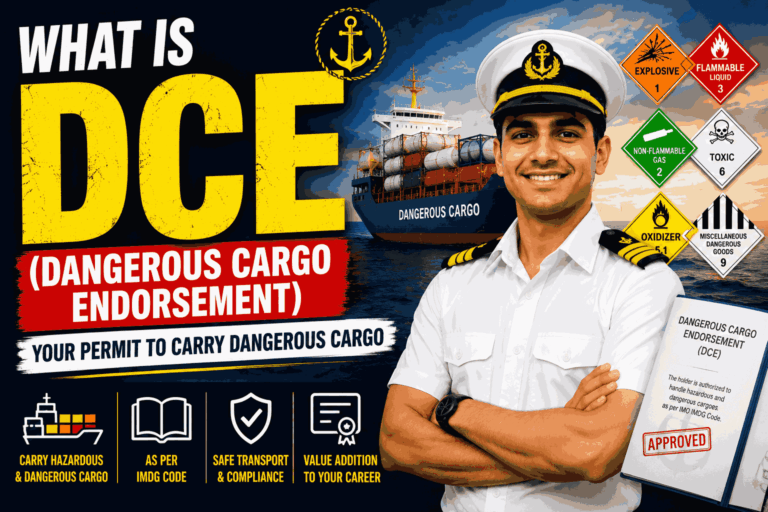

What is DCE in the Merchant Navy? Complete Guide to Dangerous Cargo Endorsement for Indian Seafarers

What is Dangerous Cargo Endorsement (DCE)?

Dangerous Cargo Endorsement (DCE) is one of the most crucial credentials held by seafarers who serve on tanker ships. The term “DCE” is extensively searched on the internet by many students of Merchant Navy and Indian Seafarers looking for terms such as DCE credential, DG Shipping DCE, tanker credential, DC credential, and DCE application, among others, due to its significance in getting jobs on ships that transport dangerous goods.

Dangerous cargo refers to goods that consist of petroleum-based products, crude oil, chemicals, liquefied gas, and other hazardous items that necessitate special handling on board ships due to the associated fire hazards, explosions, pollution, and toxicity. Therefore, all seafarers employed to handle ships loaded with dangerous cargo must be trained appropriately and acquire Dangerous Cargo Endorsement certificate.

Currently, DCE holds considerable importance in tanker shipping occupations since no shipping company is legally authorized to employ seafarers on oil tankers, chemical tankers, or gas tankers without appropriate tanker credentials.

Why DCE is Important in Merchant Navy

The tanker ship is considered to be among the highest paying careers within the Merchant Navy, but it has comparatively greater risk factors as compared to the normal freight carriers. This is because the tanker ships are involved in the transport of dangerous cargos through international waters, where any small error could prove disastrous not only for the crew but also for the environment and cause an explosion.

That is why the IMO and DG Shipping ensure that seafarers have undergone special training regarding handling of dangerous cargo.

  • With regards to the certificate of Dangerous Cargo Endorsement, a seafarer must know about:
  • Tanker operations
  • Handling of dangerous cargos
  • Emergency response activities
  • Systems on tankers
  • STCW tanker training guidelines

It is therefore very important for students aspiring to work in the tanker ship as part of their Merchant Navy career.

Why Tanker Ships are Popular Among Indian Seafarers

One of the biggest reasons tanker fleets attract so many seafarers is because tanker shipping is often financially rewarding. Oil tankers, chemical tankers, and gas carriers operate under highly specialized conditions where safety, discipline, and technical knowledge are extremely important. Since the work environment involves dangerous cargo operations, shipping companies generally prefer professionally trained crew members who understand tanker safety procedures and emergency handling systems.

Because of this specialization, tanker ships often provide better salaries and stronger promotion opportunities. Many experienced officers and ratings intentionally move toward tanker fleets after gaining initial sea experience because tanker exposure is highly valued throughout the global shipping industry.

For freshers entering the Merchant Navy sector, tanker certification can eventually become an important advantage during recruitment and promotion stages.

Why DCE is Mandatory for Tanker Jobs

Many students assume DCE to be yet another document required by sea laws and maritime practices; however, DCE actually makes an important impact on whether or not a seafarer is permitted to work onboard tanker vessels. According to international maritime laws, tanker crew members must receive special training for dangerous cargo operations.

It is important to note that shipping companies are not able to employ inexperienced crew members on tanker vessels since the risk level is much higher than when dealing with regular cargo vessels. This is because tanker vessels usually handle flammable, poisonous, and dangerous cargoes where any mistake can lead to fires, explosions, and accidents at sea.

For this reason, DCE certificate becomes very important as it guarantees that a seafarer has gone through tanker safety training. Without a DCE certification, seafarers may find themselves unable to obtain employment on tanker vessels despite other maritime qualifications they might possess.

How DCE Helps Seafarers Build Better Careers

While some Merchant Navy students are obsessed with securing their first ship, seasoned seafarers appreciate the importance of having a good career plan in place. Specialized qualifications such as Dangerous Cargo Endorsement sometimes enable seafarers to access lucrative and more advanced shipping segments.

Tanker experience is well regarded throughout the world as there is a high level of professionalism involved in tanker operation. Seafarers engaged in tanker operation have knowledge about cargo handling, emergency situations, pollution prevention, and tanker laws worldwide.

Tanker experience gives seafarers an edge in:

  • tanker companies,
  • offshore companies,
  • LNG transport,
  • oil & gas carriage,

Tanker experience turns out to be the most precious experience for many officers and crewmen in their entire maritime careers.

Difference Between Level 1 and Level 2 DCE

Merchant Navy students often get confused about Level 1 DCE and Level 2 DCE qualifications. In simple language, both these certificates refer to two different levels of tanker training and qualifications.

Level 1 DCE certificate is referred to as Basic Training for Tanker Cargo Operations and it is mandatory for operational level seafarers onboard tanker ships. The basic certification emphasizes tanker familiarization, safety measures, emergency response procedures, and cargo operations.

Level 2 DCE refers to Advanced Tanker Training, and it is mainly designed for seafarers who are assigned management level duties onboard tanker ships. Advanced certification usually requires sea service experience because managing tanker vessels is more complicated and difficult.

The distinction between the two certifications is crucial since most students have an erroneous impression that advanced tanker training is directly available to them.

How to Apply for DCE Online

The application process for Dangerous Cargo Endorsement is handled through the DG Shipping E-Governance system. Over the years, DG Shipping has shifted many maritime certification procedures online to improve transparency and reduce documentation delays.

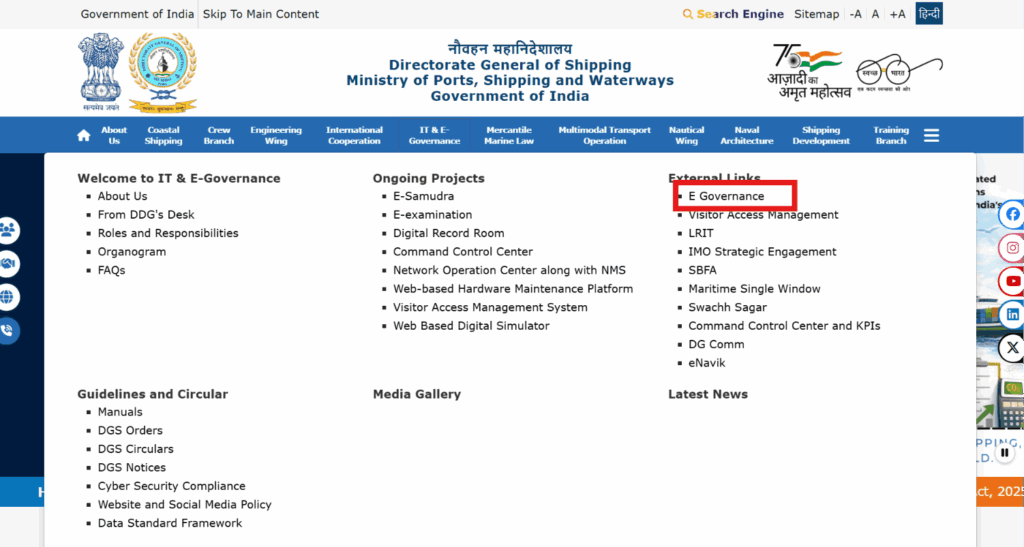
  1. Go to DG Shipping Website. Click on IT & E-Governance in the menubar.
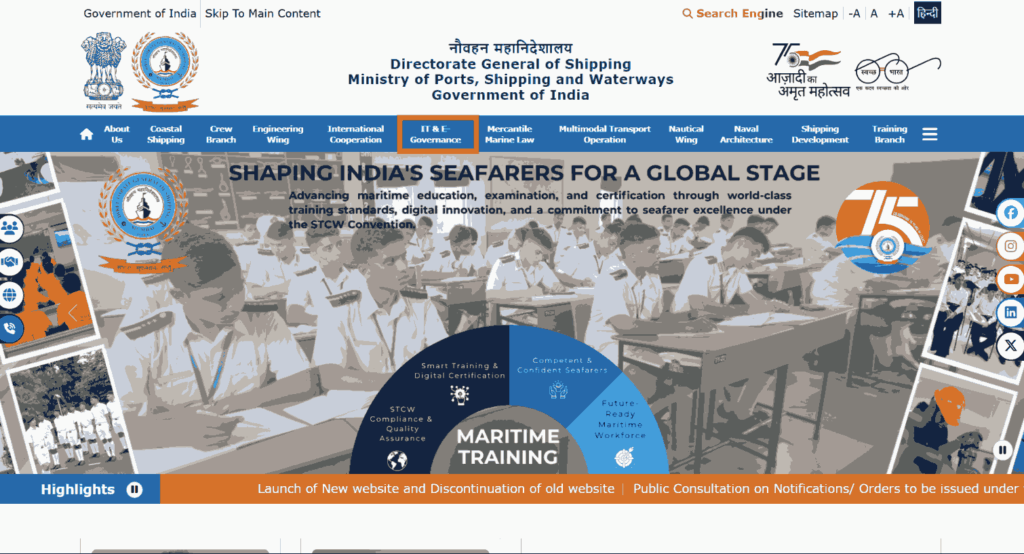
  2. Visit the DG Shipping Website and hover on the tab titled ‘ E-Governance’ As the drop-down menu appears, click on the tab titled ‘e-governance’
 

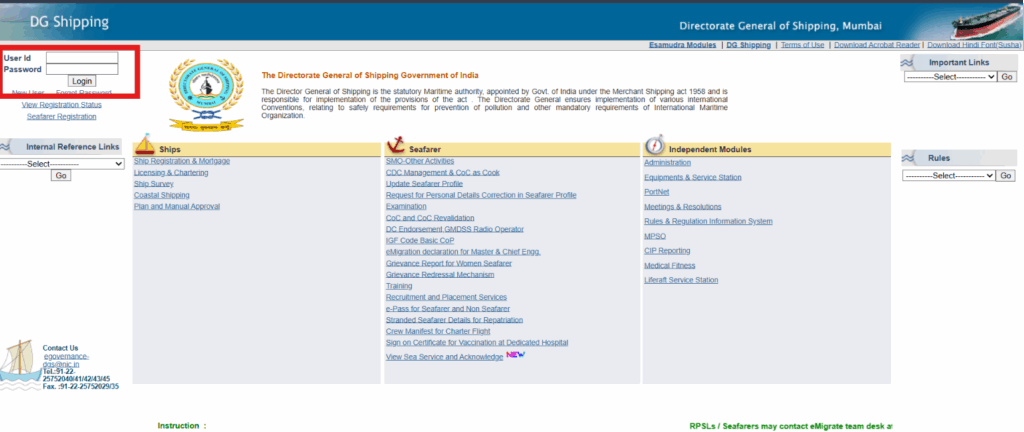
  1. Log in with your User ID and Password


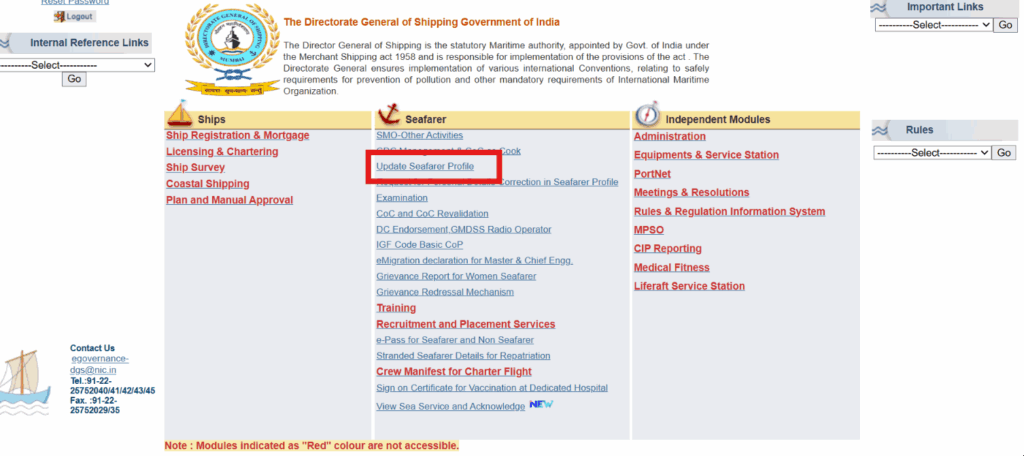
  1. Click on the link that says ‘Update Seafarer Profile’
 

  1. Click on the ‘COP’ tab and select ‘ Check the Eligibility’

 

  1. Select from the drop-down menu ‘DC Basic Oil & Chemical’ or ‘DC Basic Liquified Gas’ and click on the ‘continue’.

 

  1. Check the Documents to be uploaded Once you complete step 6, you will be shown a list of documents that you to upload. The ones that have not been uploaded will appear in red.
  2. Click on the ‘Documents tab’ and select ‘Upload Documents’

Upload the following documents in proper format:

  1. Self-attested scanned copy of Passport (first, and last two pages) in pdf.
  2. Self-attested scanned copy of CDC in pdf.
  • After submitting all documents, come back to the COP Eligibility section
    • You will now be able to apply for DC endorsement. Click on ‘apply now’
    • The Dangerous Cargo Endorsement Certificate should be available within 2-3 working Days.
  • Generate DC Endorsement Certificate from Indos/COP Checker

Within 2-3 Working days, you should be able to view and generate your DC Endorsement Certificate using the Indos/COP Checker. 
How Shipping Companies Verify DCE Certificates

In today’s world, shipping has become increasingly digitized, and all certificates related to mariners are usually authenticated online prior to the vessel joining process. Shipping organizations often check:

  • DCE certificates,
  • INDoS details,
  • CDCs,
  • STCW certificates,

as well as documents related to their sea service experience.

If there is any discrepancy in tanker endorsements or documentation issues, it can lead to delay or even rejection of seafarers during the recruitment process. Thus, maintaining the correct marine documentation has become vital for Indian Seafarers working in international waters.

Why Tanker Experience is Highly Valued in Shipping

Operational standards of tanker shipping are relatively higher than those for most other types of ships. Seafarers employed in tankers work in an environment that is associated with dangerous cargo, high safety protocols, stringent compliance requirements, and emergency handling facilities.

It is due to this reason that experience in tanker shipping adds a lot to one’s credentials as a seafarer. Most of the international shipping firms consider candidates with tanker experience preferable since tanker experience indicates professionalism, competence, and maritime expertise of a seafarer.This is one of the reasons why many seafarers ultimately take up tanker shipping.

Future Importance of DCE in Merchant Navy

The shipping industry continues to evolve into a more safety-conscious, technological, and regulated entity with every passing year. In particular, the operations of tankers call for crew members who have knowledge about maritime safety regulations and operations in relation to dangerous cargo.

Since the tanker shipping sector is growing globally, the significance of obtaining a Dangerous Cargo Endorsement for Indian Seafarers will only increase with time. Youngsters who intend to make a career within the Merchant Navy should familiarize themselves with tanker certification procedures in order to be provided with greater job opportunities, salaries, and career growth potential in the future.

DCE is thus not merely another certificate that young Merchant Navy students need to obtain. Rather, it is a crucial step towards joining the most prestigious part of the shipping industry worldwide.


Published by Aditya Kumar at MerchantNavyDecodedJobs.com — Your trusted guide to a career at sea.
Source: DG Shipping Casualty Investigation Report | Incident Date: 04 January 2023