When Silence Costs a Ship: The Steering Gear Flooding Incident of January 2023
A critical look at how a neglected bilge alarm and a disabled hatch sensor pushed a vessel to the brink — and the lessons every aspiring mariner must carry.
In the demanding world of merchant seafaring, a lapse in judgment lasting mere minutes can cascade into a crisis spanning days. The incident that unfolded on January 4, 2023, aboard a vessel navigating heavy weather off the Mumbai coast is a sobering testament to this reality — and a case study that every deck officer, marine engineer, and rating aspirant must study closely.
Incident Summary
At 0440 hrs on 04/01/2023, the steering gear compartment bilge high-level alarm was activated. Upon inspection, the compartment was found flooded with all azimuth system equipment submerged up to the upper gearbox level, resulting in total loss of propulsion.
The Chronology of a Crisis
Understanding how a manageable alarm escalated into a full salvage operation requires a careful reading of the timeline. Every hour that passed without decisive action compounded the danger.
- 0343 hrs — The Alarm Sounds
- 0440 hrs — Flooding Confirmed
- 0800 hrs — Propulsion Fails
- 04–05 Jan — Salvage Mobilized
- 07 Jan, 0115 hrs — Tug Arrives
- 11 Jan, 2200 hrs — Safe Harbor
The Root Cause: A Disabled Alarm and a Culture of Silence
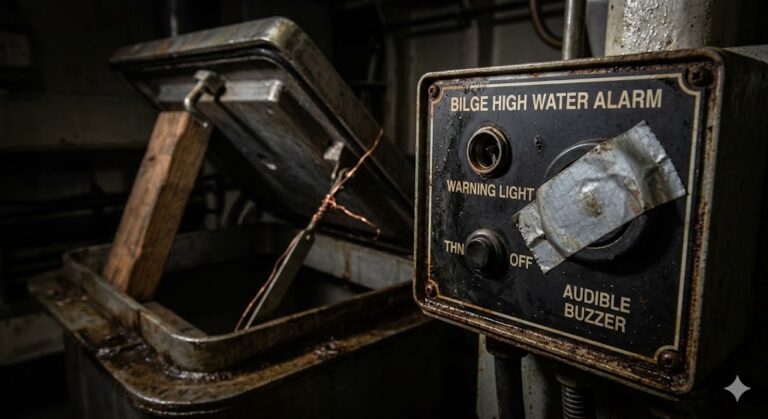
Investigation revealed that water ingress had occurred through the port side booby hatch of the Steering Gear Compartment — which had been left open. More alarmingly, the alarm indication for this booby hatch had been deliberately disabled by the ship’s staff, leaving no indication in the ECR that the hatch was open.
This incident is not simply about a flooded compartment. It is about a chain of decisions — each individually small, cumulatively catastrophic — that eroded the vessel’s defenses layer by layer.
Lessons for Every Mariner and Aspirant
At MerchantNavyDecodedJobs, we believe that casualty knowledge is career knowledge. Every aspiring officer and engineer must internalize what went wrong here — because these are precisely the scenarios examined in oral examinations, competency assessments, and real shipboard emergencies.
Acknowledging an alarm stops the audible alert — it does not resolve the underlying condition. A duty engineer who acknowledges without investigating has only silenced the warning, not addressed the hazard. Always investigate. Always log. Always inform.
Adverse sea conditions heighten, not reduce, the urgency of responding to safety-critical alarms. If safe entry to a space is genuinely impossible, that must be communicated immediately to senior officers and watchkeepers — not used as a reason to take no further action.
The disabling of the booby hatch alarm indicator was a fundamental breach of safety management. Alarms exist as the ship’s immune system. Bypassing them — even temporarily — removes the early warning that allows crews to prevent minor issues from becoming major casualties.
Watertight integrity checks are not box-ticking exercises. Every door, hatch, and air vent must be confirmed closed, operational, and alarm-ready before a vessel sails for open sea. This is the first line of defense against flooding — and it had failed here before the voyage even progressed.
The Corrective Actions Mandated
Following the investigation, a set of mandatory corrective measures was prescribed for all vessels:
- Watertight integrity to be physically checked and logged before every sea departure. A copy of the inspection report is to be submitted to the DPA/ADPA for verification.
- All watertight door and booby hatch alarm monitoring systems must be activated and confirmed operational at all times during a voyage.
- The inspection cover of the watertight compartment below the shark jaw/towing pin must be properly secured prior to departure.
- No leakage from the shark jaw or towing pin into the steering room is acceptable. Regular inspection of all air vents in the steering room is mandatory.
- DG Shipping, classification society, Indian Coast Guard, and MRCC must be informed immediately upon any major safety incident. Regular position reports are mandatory during any distress or salvage situation.
Final Word
A single acknowledged-but-unattended alarm at 0343 hrs. A disabled hatch indicator. A compartment left uninspected. These were not dramatic failures — they were quiet ones. And quiet failures, aboard a ship at sea, can be the most dangerous of all.
Every officer on watch, every engineer on duty, and every rating standing rounds carries the safety of the vessel and all aboard. The sea does not offer second chances easily. But study, vigilance, and a commitment to safety culture can ensure that the lessons of others do not have to be learned at personal cost.
Stay safe. Stay informed. Sail with knowledge.
Published by Aditya Kumar at MerchantNavyDecodedJobs.com — Your trusted guide to a career at sea.
Source: DG Shipping Casualty Investigation Report | Incident Date: 04 January 2023
